Most common question asked by folks looking to get started in ham radio is, “where do I begin?“
First, THE BASICS
There are a total of 409 questions in the current Amateur Technicians license exam pool. These categories are divided into 10 “main” categories.
Each category has multiple groups. The exam is compromised of 1 random question from each group, totally 35 multiple choice questions.
Category – Total Number of Questions – Number of Groups (in each Category) – Number of Exam Questions (1 random question from each group)
- T1 – Commission’s Rule – [68 Questions] – 6 Groups / 6 Exam Questions
- T2 – Operating Procedures – [37 Questions] – 3 Groups / 3 Exam Questions
- T3 – Radio Wave Propagation – [35 Questions] – 3 Groups / 3 Exam Questions
- T4 – Amateur Radio Practices – [23 Questions] – 2 Groups / 2 Exam Questions
- T5 – Electrical Principles – [50 Questions] – 4 Groups / 4 Exam Questions
- T6 – Electronic and Electrical Components – [46 Questions] – 4 Groups / 4 Exam Questions
- T7 – Practical Circuits – [44 Questions] – 4 Groups / 4 Exam Questions
- T8 – Signals and Emissions – [47 Questions] – 4 Groups / 4 Exam Questions
- T9 – Antennas and Feedline – [23 Questions] – 2 Groups / 2 Exam Questions
- T0 – Safety – [36 Questions] – 3 Groups / 3 Exam Questions
NOTE: Every four (4) years, the question pool is updated, so make sure that you are studying from the current pool.
As of this writing the current material/books are 2026 – 2030.
35 questions are randomly chosen to be on the exam (see above for number of exam questions selected from each category).
This is a PASS/FAIL exam, which means you can receive your license, whether you make a 72% or 100% (you can miss a maximum of 9 questions and pass).
A bit of HOUSEKEEPING –
I would be remiss, I did not bring this to your attention first. Because everyone wants to get a radio and start “listening”, before they get their license, a bit of advise/caution…..
****IF YOU BUY A RADIO BEFORE YOU ARE LICENSED, PLEASE DISABLE THE RADIO’S ABILITY TO TX(Transmit)**** (this can EASILY be done through radio programming software, like CHIRP)
–>Transmitting on ham frequencies without a license for ANY REASON, violates FCC rules. You can re-enable it once you have earned your license.
NOW, with that out of the way, LET’S GET STARTED!

STEP 1 – APPLY FOR YOUR FRN (FCC Registration Number)
This is a requirement by the FCC to validate who you are and will be used for any/all FCC issued licenses.
You only need to do this once, and it is also good for GMRS (ZA) license applications.
PRIVACY NOTICE: The physical address you use in the application will be public facing. If you prefer not to have your home address published, it is recommended that you use a PO Box.
Whatever address you use, MUST be able to receive correspondence. If the FCC mails something to that address you provide and it is returned, they will suspend any license you are issued. So, don’t try to “fool the system”.
The link for registering for your FRN : https://apps.fcc.gov/cores/userLogin.do
SIDE NOTE: To clear up some confusion for those new to the process, you do not “apply” for a ham license. It will be issued to you by the FCC, after successfully passing your exam.
STEP 2 – ACQUIRE STUDY MATERIALS
I am aware that everyone has their own learning styles, so I will list some that worked for me and others:

 .
. 
- Gordon West – 2026-2030 Technician Class (yellow book) – my personal preference
- ARRL Ham Radio License Manual Spiral 6th Edition
- Technician Class: Pass Your Amateur Radio Technician Class Test – The Easy Way by Craig “Buck” K4IA
- The Ham Radio Prep Technician Class License Manual (2026 – 2030 Edition) – you can also sign up for their online training. – *They currently offer a FREE PDF version of their study guide*
STEP 3 – PRACTICE EXAMS
Once you have read through the material of your choice, begin taking “practice exams”. Be sure you make use of a variety of sources. Each source will randomly generate 35 questions, but they may not cover everything thoroughly. Utilizing multiple sources, ensures your greatest possibility of success. Some that I used and recommend are:
- any “FREE” App/s for on your cell phone (search for Ham Exam Practice, or similar terms)
- Hamstudy.org
- hamexam.org
- http://arrlexamreview.appspot.com/
When you are consistently making > 85% across ALL of the practice exams/apps, it is time to schedule your exam.
NOTE: IF you have the time and IF you feel confident with your preparation for the Technician exam, you could (optional) study for the General as well. Once you pass the Technician exam, you may also take the General exam in the same sitting, without incurring any additional fees.
STEP 4 – SCHEDULE YOUR EXAM
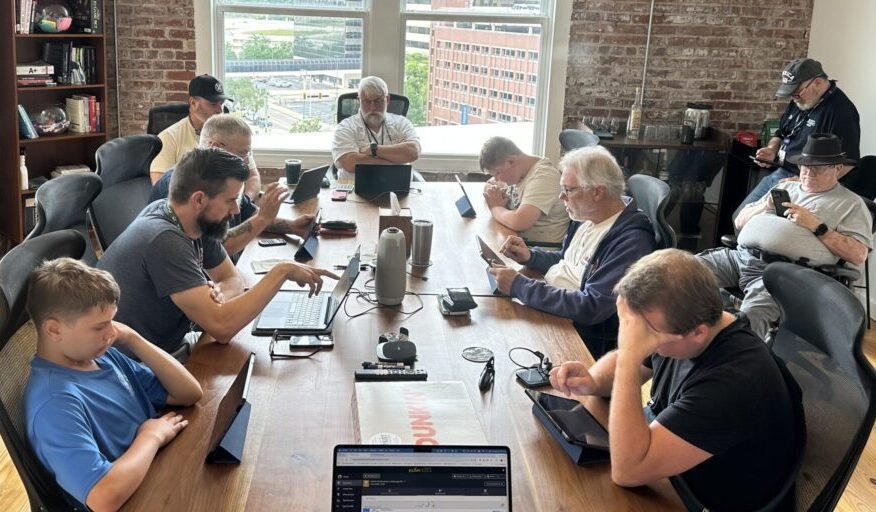
Look for an exam in your local area. I recommend an “in-person” exam, as it allows you to find and interact with other local hams in your area and develop relationships.
However, if there are no local clubs or exam opportunities, you have the option to take you exam online with a variety of VEC groups (ie. ARRL, GLAARG and W5YI).
What you will need to bring with you to an in-person exam:
- State issued photo ID or passport
- Exam fee (typically $15 – cash or check)
- If applicable – glasses used to read computer screen as most VE Exams are now given on computer tablets.
After successfully passing your exam/s, the FCC will receive your application from the VEC (the team that proctored your exam) and you will receive an email with instructions to pay the $35 processing fee. You must pay within 10-days from a computer. DO NOT pay from a mobile device, as there are known to have issues with the FCC’s processing system.
You will be issued your FCC Amateur Radio license within 24-hours of receipt of payment, unless it is a weekend or federal holiday. As soon as your FCC license appears in the FCC ULS database, you are officially a licensed ham radio operator and can now transmit on frequencies and modes you are licensed for. Check your email for the link to download and print your license.
CONGRATULATIONS! I look forward to hearing you on the air!
73